
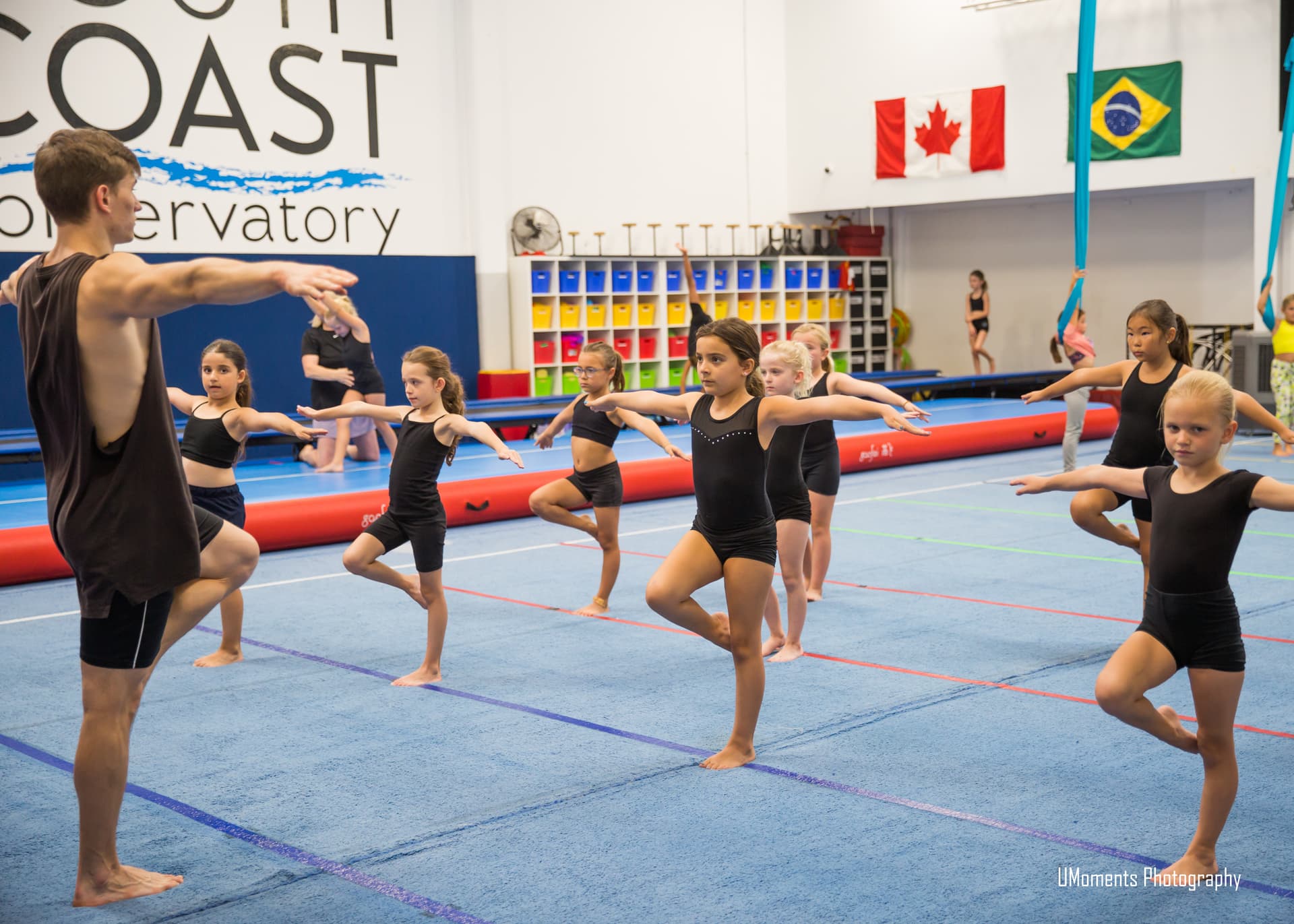
Acro vs. Tumbling: What’s the Difference and Which Is Right for Your Child?
A parent’s guide to acrobatic dance, tumbling, and finding the right fit

Founder & Director
Monthly Blog Article 79
At South Coast Conservatory, one of the most frequent questions our front desk receives from parents is: "What is the difference between Acro and Tumbling, and which class should my child take?"
While both disciplines build strong, athletic, and confident movers, they serve different performance goals and utilize distinct techniques. Here is everything you need to know to make the best choice for your young athlete.
At a Glance: Key Differences
| Feature | Acro (Acrobatic Dance) | Tumbling |
|---|---|---|
| Primary Focus | Blending classical dance technique with fluid tricks | Power, height, and explosive floor passes |
| Surface | Hardwood dance floors or marley floors | Spring floors, rod floors, and thick crash mats |
| Core Elements | Flexibility, limbering, contortion, and balance | Gymnastic flips, handsprings, and tucks |
| Transitions | Seamless movement connected directly to music | Running starts into linear, high-energy passes |
| Footwear | Barefoot or dance shoes | Cheer shoes, sneakers, or barefoot |
What Is Tumbling?
Tumbling is a sub-discipline of gymnastics and cheerleading focused exclusively on floor skills. Tumblers do not train on apparatuses like the balance beam or uneven bars; instead, they concentrate on power skills performed across a sprung floor.
- Focus Skills: Cartwheels, round-offs, back handsprings, back tucks, and layovers.
- Key Traits: Explosive power, momentum, and height.
- Best For: Children interested in gymnastics, cheerleading, or power sports where high-impact floor passes are the priority.
What Is Acro (Acrobatic Dance)?
Acro is an art form that seamlessly integrates classical dance technique (such as ballet and jazz) with acrobatic elements. Unlike gymnastics, where skills are evaluated strictly on biomechanics, Acro focuses on how fluidly a skill enters and exits a piece of choreography.
- Focus Skills: Elbow stands, chest stands, walkovers, aerials, and partner lifts, combined with expressive dance steps.
- Key Traits: Deep flexibility, core control, musicality, balance, and seamless transitions.
- Best For: Dancers wanting to expand their skill set, build total-body flexibility, and stand out in performance or competitive dance.
Why Should Parents Sign Their Child Up for Acro?
While Tumbling is fantastic for pure power, Acrobatic Dance provides a balanced, holistic athletic training regimen that benefits young movers across every sport and art form.
1. Superior Flexibility & Core Strength
Acro places a strong emphasis on limbering—developing back, shoulder, and hip flexibility safely through structured progressions. This paired with deep core conditioning protects young athletes from injury.
2. Versatility Across Dance Disciplines
Adding Acro skills (such as walkovers, side aerials, and chin stands) to a dancer’s repertoire makes them significantly more versatile. Modern jazz, contemporary, and lyrical routines frequently incorporate Acro elements.
3. Grace and Body Control
Because Acro is taught on a standard studio floor rather than a high-bounce spring floor, students learn absolute muscle control. Every landing must be soft, silent, and graceful, instilling strong spatial awareness and discipline.
4. Partnering & Teamwork
Acro classes teach young performers essential co-regulation skills through partner balancing, weight-sharing, and group pyramids—fostering trust and team bonding in every session.
Next Steps at South Coast Conservatory
If your child loves flipping in the living room or wants to refine their dance artistry, our certified instructors at South Coast Conservatory offer guided progression levels to keep them safe, challenged, and inspired.
ENROLL IN AN ACROBATICS CLASS TODAY
Laguna Niguel & Laguna Hills, CA