
The Dance Dilemma: Why Letting Go Helps Your Child Soar
How stepping back helps young dancers build self-reliance, trust, resilience, and confidence

Dance Director
Monthly Blog Article 74
Every parent wants to see their child succeed. When you watch your child pour their heart out on the studio floor, it's completely natural to want to protect them, correct them, and ensure they get the spotlight they deserve.
But there is a fine line between being a supportive dance parent and becoming a “helicopter parent.” In the high-stakes, highly disciplined world of dance training, hovering too closely can actually stall your child's progress.
The Hidden Cost of Hovering
Helicopter parenting—micromanaging a child's schedule, questioning the choreographer's or coach's decisions, or giving technical notes from the studio lobby—comes from a place of love. However, in a dance environment, it often backfires in three distinct ways:
- It Suffocates Self-Reliance: Dance is as much a mental game as it is a physical one. When parents step in to solve every conflict or pack every dance bag, dancers miss out on developing vital problem-solving skills and accountability.
- It Creates Mixed Signals: When a coach tells a dancer to work on their turnout a certain way, but a parent gives different advice on the car ride home, the dancer becomes confused. This split focus hinders muscle memory and technical growth.
- It Fuels Performance Anxiety: Kids are incredibly perceptive. If they feel their parent is hyper-focused on every mistake, the studio stops being a safe space to fail and learn. Instead, it becomes a pressure cooker.
The Power of the Triad: Parent, Dancer, and Educator
At South Coast Conservatory, we don't just train dancers; we build a community. True athletic and artistic success relies on a healthy, respectful partnership between parents and our faculty.
Think of your child's dance education as a triad. When all three sides are strong, the structure is unbreakable:
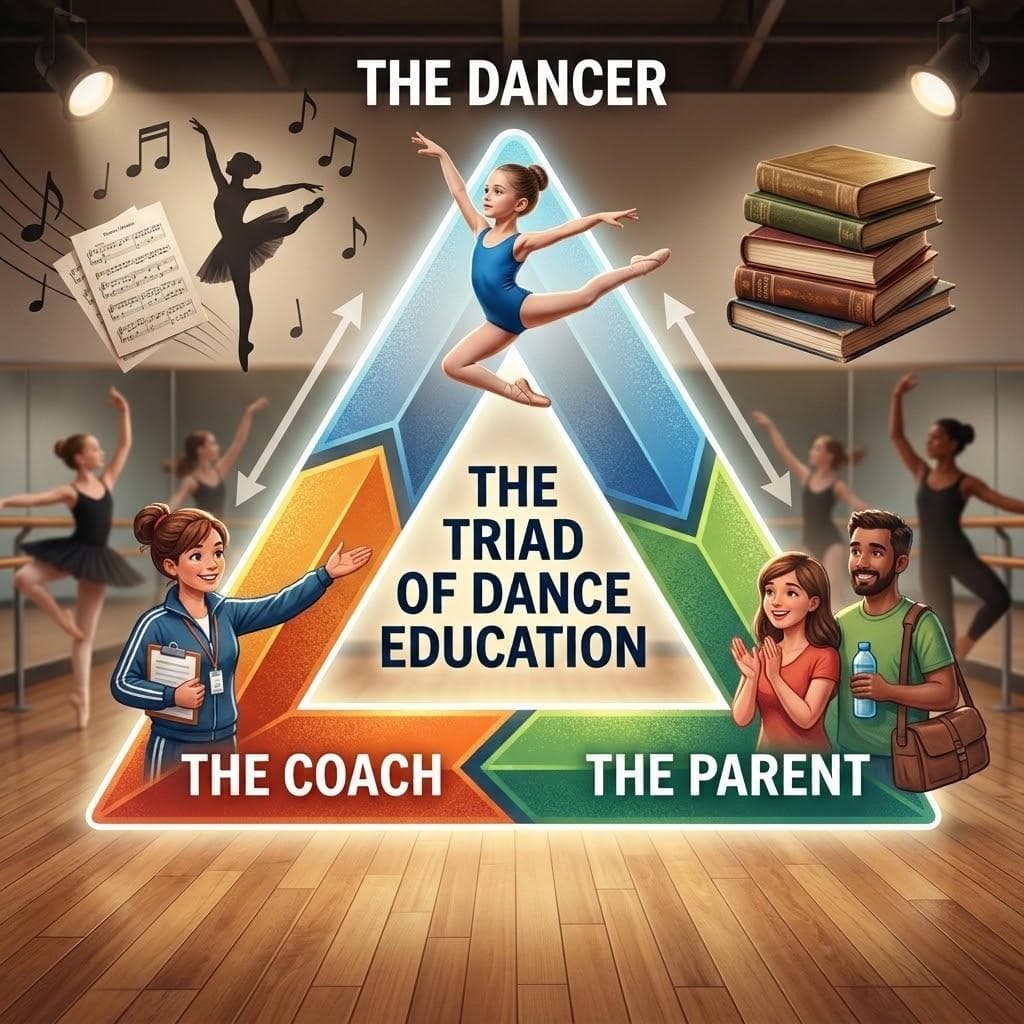
Our educators at SCC are highly trained professionals who understand the anatomy, psychology, and trajectory of a developing dancer. When parents trust this expertise, it creates a unified front. The dancer feels secure knowing that the adults in their life are on the same page, allowing them to focus entirely on their artistry and technique.
Success Happens When Coaches Coach (and Parents Parent)
What happens when you step out of the studio wings and trust the process? Incredible transformation.
When parents let the coach do the coaching, the benefits to the young dancer are immediate:
- Accelerated Growth through Vulnerability. Being a performing artist requires making mistakes. When a performer knows their parent isn't judging their stumbles from the viewing window, they take bigger risks. They fall, they figure out why, and they stand up and try again even stronger.
- Stronger Coach-Dancer Bonds. A dancer needs to look to their instructor for correction and validation. When parents step back, it allows a deep bond of trust to form between the coach and the student, which is essential for mastering complex choreography and technique.
- Unconditional Support. When you relinquish the role of “critique master,” you get to step into your most important role: the safe harbor. Your child doesn't need another coach; they need a parent who celebrates their passion, hands them a water bottle after a grueling rehearsal, and loves them whether they are in the front row or the back row.
How to Be an Awesome Parent Partner
Supporting your South Coast Conservatory dancer doesn't mean being hands-off. It means redirecting your energy into the ways that matter most. You can practice healthy partnership by:
- Cheering for the whole team: Celebrate the growth of all dancers in the class, not just your own.
- Respecting the studio boundaries: Trust that behind closed doors, our educators have your child's best interests and safety at heart.
- Keeping the car ride home positive: Instead of reviewing what went wrong in class, try asking, “What was the most fun thing you learned today?” or simply saying, “I loved watching you dance.”
The beautiful truth of dance training is that the studio is a rehearsal space for life. By allowing your child the space to navigate their own challenges, receive professional feedback, and earn their successes, you aren't just helping them become better dancers—you are helping them grow into resilient, independent, and confident young adults.
Let's work together to let them fly.
Laguna Niguel & Laguna Hills, CA