
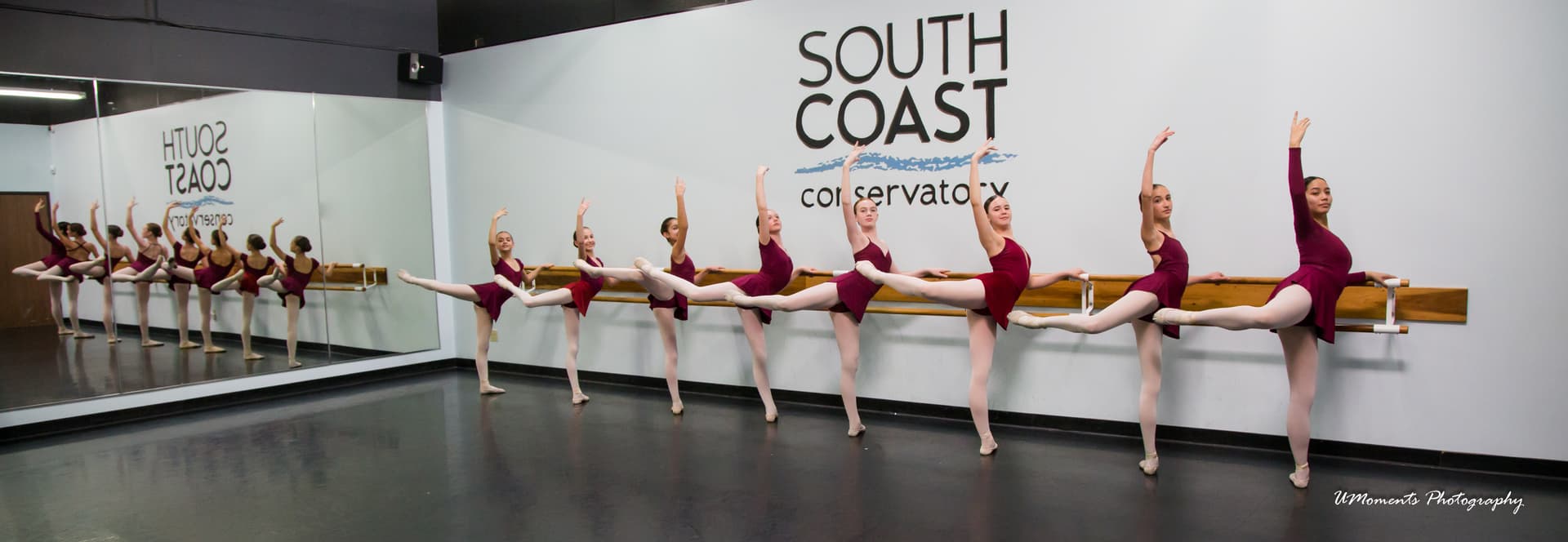
Why Technique is a Dancer's Best Insurance Policy
How technical precision protects dancers and supports lasting performance

Dance Director
Monthly Blog Article 71
In the world of elite dance training, the line between a breathtaking performance and a season-ending injury is often drawn by a single factor: technical precision. While many people see ballet or contemporary dance as purely aesthetic, it is, at its core, an athletic discipline governed by physics and biomechanics.
At South Coast Conservatory, the philosophy is simple: great dancers are not just born. They are developed through meticulous training. Under the guidance of seasoned dance and performing arts masters, students learn that technique is not about rigid rules. It is about longevity.
How Technical Mastery Protects the Body
Technical training serves as the “armor” for a dancer. When a student masters the fundamentals, they are doing more than perfecting a silhouette. They are protecting their joints and muscles.
- Proper Alignment and Force Distribution: Proper technique ensures that the impact of jumps and leaps is distributed across the correct muscle groups rather than being absorbed by the bones and ligaments. For instance, a landed jump in plie requires the heels to stay grounded to engage the glutes and hamstrings, protecting the delicate ACL and meniscus of the knee.
- The Power of Turnout: True turnout comes from the hip rotators, not the knees or ankles. SCC masters emphasize “active” turnout, which helps prevent painful tibial torsion and rolling through the arches that can lead to shin splints and stress fractures.
- Core Stability as a Center Point: A strong center is not just for balance. It stabilizes the spine during complex movements like penche or partner lifts, drastically reducing the risk of lower back strains and spondylolysis.
The SCC Advantage: Training with the Masters
What sets the training at South Coast Conservatory apart is the pedagogical expertise of its faculty. Our dance and aerial masters do not just demonstrate steps. They analyze movement patterns to identify potential red flags before they become injuries.
- Progressive Loading: The masters at SCC understand that the body needs time to adapt. By following a structured syllabus, students gradually increase the complexity of their movements. This progressive loading allows tendons and bones to strengthen, helping prevent the overuse injuries common in high-intensity environments.
- Individualized Corrections: No two bodies are the same. SCC instructors provide personalized feedback that accounts for a dancer's specific anatomy, whether that means hypermobility or tight hip flexors. This bespoke approach helps make sure a student is not forcing their body into a movement it is not ready for, which is a leading cause of acute tears.
- Cross-Training and Recovery Education: Beyond the studio floor, the SCC faculty integrates knowledge of anatomy and recovery. Students are taught how to foam roll, why eccentric calf strengthening matters for releve work, and how to distinguish between good pain like muscle fatigue and bad pain coming from joints or nerves.
Longevity is the Ultimate Goal
At South Coast Conservatory, the goal is not just to win trophies or land professional contracts. It is to ensure that our students can keep dancing for as long as they desire. By prioritizing technical integrity over tricks, our instructors empower students with a deep understanding of their own instruments: their bodies.
When you train at SCC, you are not just learning how to dance. You are learning how to thrive. By making technique your priority, you make lifelong health your result.
Laguna Niguel & Laguna Hills, CA